A Real-Life Family Home Purchase in Placer County, California
Sometimes a mortgage starts with numbers.
And sometimes it starts with a family story that keeps unfolding.
Recently, I shared the story of Jake and Elena, a California family preparing to purchase Jake’s parents’ home in Placer County.
In Part One of their story, I explained how we structured their purchase using an FHA loan, a gift of equity from Jake’s parents, seller credits and a temporary interest-rate buydown.
But that was only the beginning.
As we have continued working through their purchase, we’ve uncovered several other pieces that make buying a home from your parents very different from purchasing a traditionally listed home.
There’s a private family sale.
There’s an important California property-tax conversation involving Proposition 19.
There’s the story of the custom home Jake’s parents built next door.
And, unexpectedly, there are beavers.
Yes. Beavers.
This is Part Two.
Buying a Home From Your Parents Isn’t Always a Traditional Real Estate Transaction
When most people picture buying a house, they imagine something like this:
The seller lists the home.
A real estate agent puts it on the MLS.
Buyers tour it.
Someone writes an offer.
The parties negotiate.
Then the lender gets involved.
But what happens when you already know exactly which house you’re buying?
And the sellers happen to be Mom and Dad?
That’s essentially where Jake and Elena are.
They have already been living in this home for years. Jake’s parents live right next door. The family knows the property, knows the history and already knows who is buying it.
That means the transaction can be handled as a private sale, often referred to as a For Sale By Owner or FSBO transaction, rather than a traditional publicly marketed home sale.
That doesn’t mean you simply agree on a price, shake hands and call the lender.
There’s still a real estate transaction to complete.
The financing has to meet loan guidelines. The purchase agreement needs to accurately reflect the transaction. Escrow and title still have important roles. The property may need an appraisal. Insurance needs to be addressed. Underwriting requirements still apply.
And when family members are involved, there can be additional considerations that don’t exist in a typical arm’s-length purchase.
In Jake and Elena’s case, one of those considerations was the gift of equity we discussed in Part One.
And another surfaced during a recent conversation about property taxes.
“Wait… You May Qualify for a Proposition 19 Exclusion”
This is one of the reasons I love talking to my clients rather than simply processing their mortgage.
Sometimes one question leads to another.
During a recent conversation with Jake, we started talking about what would happen to the property’s tax assessment when ownership transferred from his parents to him.
That led us to California Proposition 19.
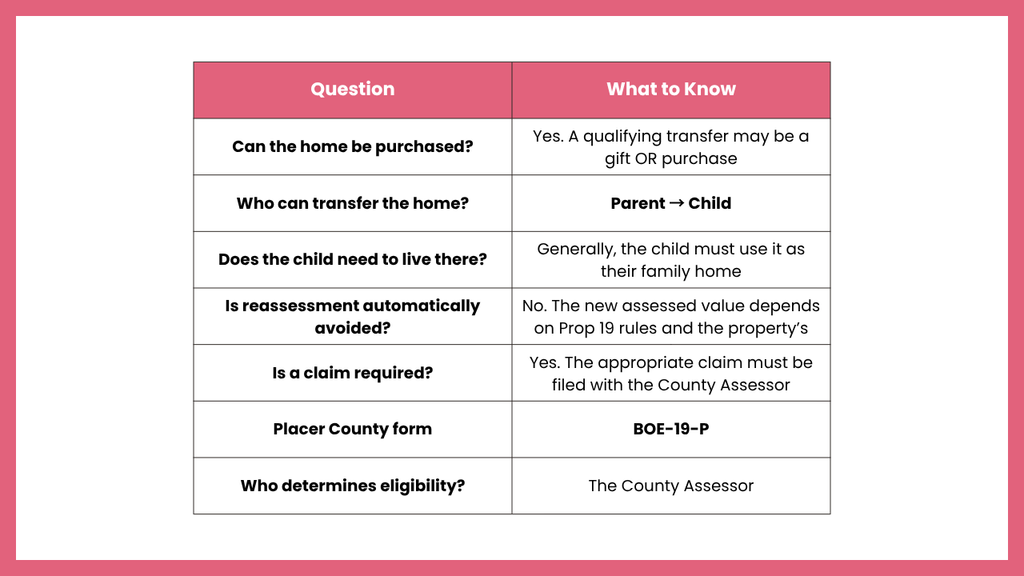
Under current California rules, certain transfers of a family home between a parent and child may qualify for an exclusion from reassessment.
And importantly for families like Jake’s, Placer County specifically states that the qualifying transfer can be a gift OR a purchase between parent and child.
That means buying your parents’ home does not automatically disqualify the transaction simply because money is changing hands.
There are, however, requirements.
For a qualifying family-home transfer, the property must meet Proposition 19 requirements, and the child receiving the property generally needs to use it as their family home. The appropriate claim also needs to be filed with the County Assessor.
In Placer County, that includes the Claim for Reassessment Exclusion for Transfer Between Parent and Child, BOE-19-P, along with the required homeowners’ or disabled veterans’ exemption for a qualifying family-home transfer.
This is important:
Proposition 19 does not necessarily mean that a child simply inherits Mom and Dad’s exact property-tax bill forever.
The calculation depends on the parents’ existing taxable value, the property’s value at the time of transfer, the applicable Proposition 19 exclusion amount and whether all eligibility requirements are satisfied.
Placer County actually provides a Proposition 19 Assessed Value Estimator that families can use to get an idea of how a qualifying transfer might affect the property’s assessed value.
The County Assessor ultimately determines the property’s assessed value and eligibility for the exclusion.
What Could That Look Like in Real Dollars?
Here’s a simple example using an $825,000 home.
One important clarification: Proposition 19 does not transfer Mom and Dad’s property-tax percentage or simply transfer their current dollar tax bill. What may transfer is their existing taxable value, also called the factored base-year value. The applicable local property-tax rate is then applied to that taxable value, along with any applicable assessments.
Let’s say Mom and Dad’s current property-tax bill is roughly equivalent to 0.40% of the home’s current $825,000 value, or about $3,300 per year.
If the property were instead reassessed at the full $825,000 market value and we used an estimated 1.20% total property-tax rate for illustration, the annual property taxes would be approximately:
$825,000 x 1.20% = $9,900 per year
That’s about $825 per month in estimated property taxes.
By comparison, the parents’ approximate $3,300 annual tax bill works out to about $275 per month.
So the difference in this simplified example is approximately:
$9,900 – $3,300 = $6,600 per year
That’s approximately $550 per month in potential property-tax savings.
But here’s what’s really happening behind those numbers.
If a $3,300 annual tax bill were based on an illustrative 1.20% tax rate, it would correspond to a taxable value of roughly $275,000. For a qualifying Proposition 19 transfer occurring between February 16, 2025 and February 15, 2027, the current intergenerational exclusion amount is $1,044,586. Add that to the hypothetical $275,000 taxable value and the value limit would be approximately $1,319,586.
Because our hypothetical home’s $825,000 market value is below that amount, the full exclusion could apply, assuming all Proposition 19 requirements are satisfied. In that example, the property would not be reassessed all the way up to $825,000 simply because ownership transferred from parent to child.
That’s why this can be such an important conversation for a family buying Mom and Dad’s home. The potential savings aren’t created by inheriting a special 0.40% tax rate. They’re created because a qualifying child may be able to retain the parents’ much lower taxable value instead of starting over with a taxable value based on today’s market value.
These numbers are for illustration only. Actual property-tax bills include the property’s official factored base-year value, the applicable tax rate and assessments, and Proposition 19 eligibility and valuation are determined by the County Assessor.
For Jake and Elena, though, it was an important question to investigate before their purchase was completed.
Because when you’re buying a home from your parents, the mortgage payment isn’t the only number that matters.
Then Our Conversation Took a Completely Different Turn
Once we started talking about the history of the property, Jake told me more about the home his parents built next door.
And this is where the story gets fun.
If you remember Part One, Jake and Elena moved onto the family property during the pandemic.
Jake’s parents eventually built their new custom home on the adjoining property.
What I didn’t know when I wrote Part One was what it took for them to build it.
Their property sits next to a protected wetland pond.
And the pond isn’t just pretty.
It’s alive.
There is wildlife everywhere.
Including beavers.
When Jake’s parents were preparing to build their custom home, they couldn’t simply submit plans and start construction.
Because of the sensitive natural environment surrounding the property, they were required as part of their permitting process to have an additional environmental evaluation performed.
According to the family, they spent approximately $6,000 bringing in a specialist to evaluate the proposed construction and determine whether building the home would adversely affect the pond and surrounding wildlife.
Ultimately, they received the necessary sign-off and were able to move forward with their custom home.
And the beavers got to keep their pond.
What Is a Biological Resources Assessment?
The story led me down another rabbit hole because I wanted to know exactly what this type of environmental review is called.
Placer County planning documents refer to a biotic resources evaluation performed by a wildlife biologist when certain development is proposed within a significant ecological resource area.
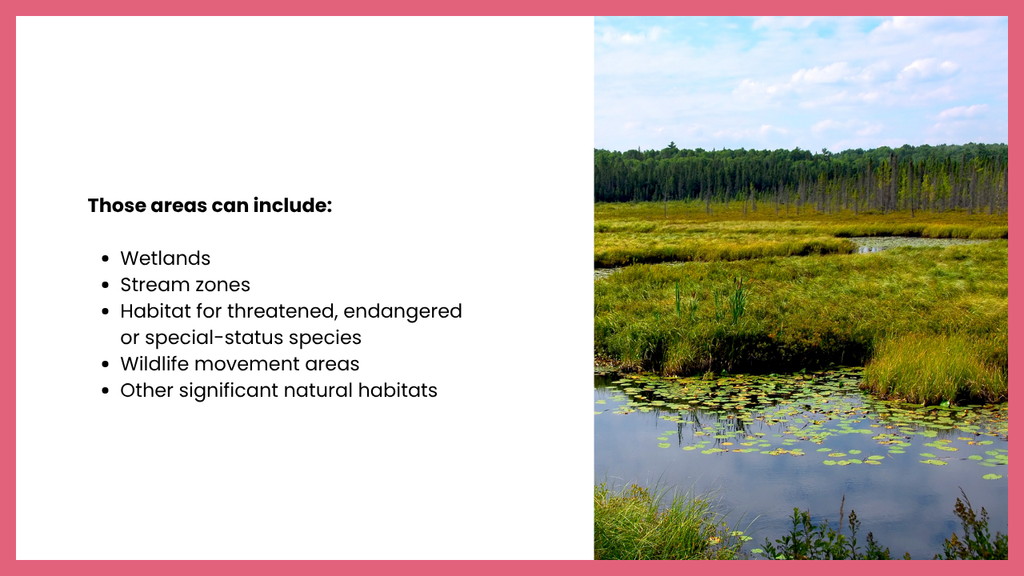
The purpose is essentially to evaluate the site and determine whether the proposed development could significantly affect biological resources and, when necessary, identify ways those impacts can be avoided or mitigated.
Depending on the property and project, additional environmental studies or agency approvals may also be necessary.
So when someone says:
“I bought land. Now I want to build my dream house.”
My next thought is:
Wonderful. Now let’s find out what comes with the land.
Custom Construction Is About More Than the House
This little beaver story illustrates something I wish more people understood before buying land to build a custom home.
Financing is only one piece of a custom construction project.
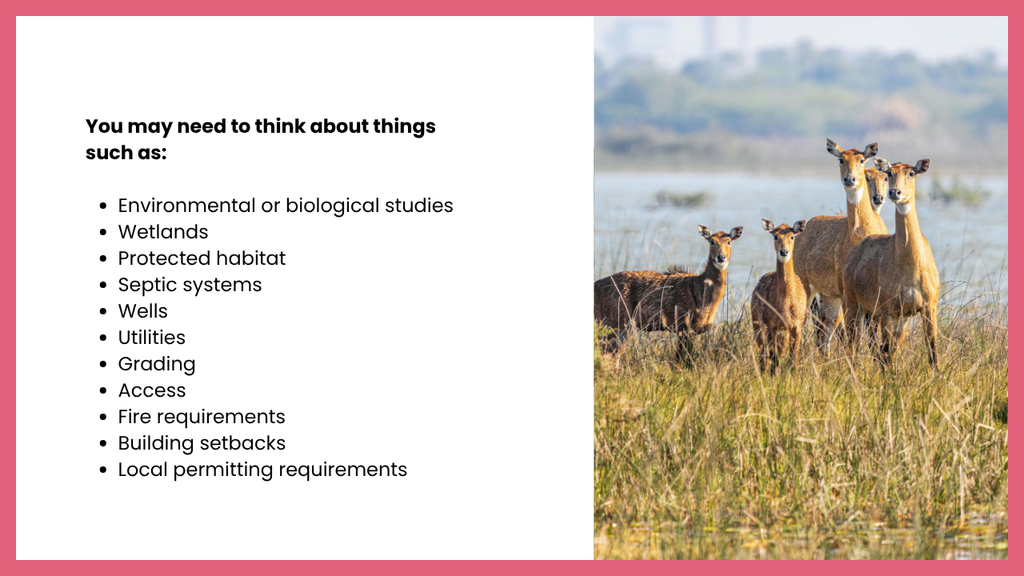
Depending on where you’re building, the land itself can create additional considerations.
None of that means you shouldn’t build.
Jake’s parents did.
They navigated the requirements and created a beautiful home next to an incredible natural setting.
But it’s a great reminder that the right property and the right financing strategy need to work together.
I also help clients explore custom construction financing, so when someone comes to me wanting to build rather than buy an existing home, I want to understand the entire project, not simply the future value of the house.
Because sometimes the most important questions aren’t about countertops and floor plans.
Sometimes they’re about beavers.
And Now the Original Home Is Passing to the Next Generation
Years ago, Jake’s parents had a vision for this property.
This is my favorite part of the entire story.
Eventually, they built another home right next door.
Their son, daughter-in-law and grandchildren continued living nearby.
Now Jake and Elena have an opportunity to purchase the family home they’ve already been living in and make it officially theirs.
In Part One, we figured out how the financing could work.
We explored FHA financing, the parents’ gift of equity, seller credits and the overall structure of purchasing a home from family.
Now we’re looking at the next layer.
- How does a private family sale work?
- What happens to the property taxes?
- Could Proposition 19 apply?
- What paperwork needs to be completed?
And what can this family’s experience teach another California family considering the same thing?
That’s what good mortgage planning looks like to me.
It isn’t simply:
“Here’s your interest rate. Here’s your payment.”
It’s understanding what you’re actually trying to accomplish and then asking enough questions to uncover the pieces you may not have known to ask about.
Thinking About Buying Your Parents’ House?
If you’re considering purchasing a home from your parents or another family member, talk with your mortgage professional before your family decides exactly how the transaction should be structured.
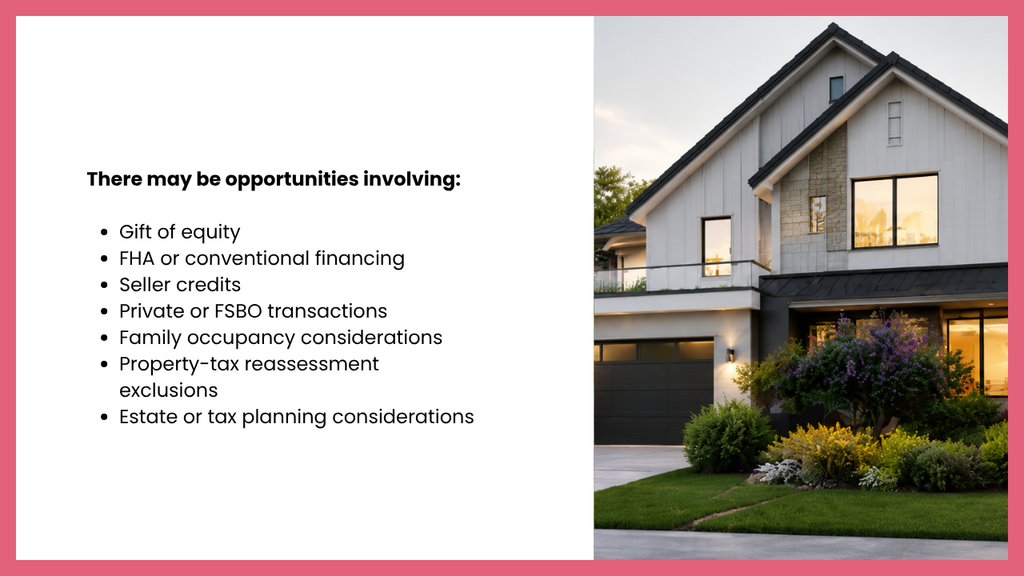
Not every option applies to every family.
And mortgage professionals don’t determine your property-tax, legal or estate-planning treatment. I encourage my clients to involve the appropriate County Assessor, CPA and estate or real estate attorney when those questions arise.
But your lender should know enough to recognize when those conversations need to happen.
That’s an important distinction.
My Complimentary Guide to Buying a Home From Family in California
After helping families navigate transactions like Jake and Elena’s, I realized there are a lot of moving pieces that buyers may not know to ask about until they’re already in the middle of the purchase.
So I created a complimentary Buying a Home From Family in California + Proposition 19 Guide to help families understand the process from beginning to end.
The guide walks you through:
- Buying a home directly from a parent or family member
- Private and For Sale By Owner (FSBO) family transactions
- Gift of equity considerations
- Financing and escrow
- California Proposition 19
- What happens after the family home purchase
- Filing BOE-19-P
- Claiming the Homeowners’ Exemption
- County deadlines, occupancy documentation and important forms
If you’re in Placer County, including Roseville, Rocklin, Lincoln, Auburn or a surrounding community, I created this resource to give you a much clearer picture of the steps involved and the questions to ask along the way.
Get My Complimentary Buying a Home From Family in California + Proposition 19 Guide
The guide is educational and isn’t a substitute for advice from the County Assessor, CPA or attorney. But it can help you understand the process, get organized and know which professionals to involve before and after the sale.
One Property. Three Generations. A Lot of Possibilities.
I started working with this family to help Jake and Elena buy a house.
But the more I learn about their story, the more I realize it isn’t really about one mortgage.
It’s about what a piece of property can mean over generations.
Jake’s parents created a home.
They built another home next door.
They protected the natural environment surrounding it.
Their grandchildren grew up with Grandma and Grandpa only a short distance away.
And now the original home has an opportunity to pass from one generation to the next.
The financing matters.
The gift of equity matters.
Proposition 19 may matter.
But the reason we’re putting all those pieces together is much simpler:
They’re keeping home in the family.
And somewhere outside, the beavers are still happily doing their thing.
Continue Jake and Elena’s Story
If you haven’t read Part One, start here:
How to Buy Your Parents’ Home With a Gift of Equity: One Family’s FHA Story
If you’re thinking about buying a home from your parents, purchasing property with family, or building a custom home of your own, I’d be happy to help you explore the financing side and identify the questions worth asking before you move forward. You can also visit my First-Time Home Buyer Resource Center or use my step-by-step Homebuyer Checklist to understand the larger purchase process.
Helpful Resources for Buying a Family Home in California
I want this article to be useful long after you’ve finished Jake and Elena’s story. These are the resources I recommend keeping handy if you’re considering a parent-to-child home purchase in California:
- Amy’s Complimentary Buying a Home From Family in California + Proposition 19 Guide – My step-by-step resource covering family and FSBO purchases, gift of equity, financing, escrow, BOE-19-P, the Homeowners’ Exemption and what to do after closing.
- Jake and Elena’s Gift of Equity Story, Part One – See how we structured this family’s FHA purchase using a gift of equity, seller credits and a temporary rate buydown.
- Amy DeBusk First-Time Home Buyer Resource Center – Mortgage education, loan programs, guides and resources for California homebuyers.
- Amy DeBusk Homebuyer Checklist – A step-by-step overview of the homebuying process from preparation through closing.
- California State Board of Equalization Proposition 19 Resource Center – The state’s primary Proposition 19 information page, including parent-child transfer requirements and filing guidance.
- California BOE Proposition 19 Fact Sheet – A useful explanation of the intergenerational transfer exclusion, taxable value and the current value limitation.
- California BOE Property Tax Forms – State information about BOE-19-P, the Homeowners’ Exemption and other property-tax forms administered by county assessors.
- Placer County Family Transfers – Placer County’s guidance and forms for qualifying parent-child and grandparent-grandchild transfers.
- Placer County Proposition 19 Assessed Value Estimator – Estimate how a qualifying Proposition 19 transfer could affect the assessed value of a family home.
- Placer County Biological Resources Information – An example of Placer County biological-resource requirements, including evaluation by a wildlife biologist for certain development involving significant ecological resources such as wetlands.
Amy DeBusk
- Branch Manager | Certified Mortgage Planner
- NMLS #281056
- Licensed in CA, TN & TX
- Amy DeBusk Home Loans | loanDepot
All loans subject to approval. Equal Housing Lender.
This article is for educational purposes only and is not tax, legal or estate-planning advice. Property-tax exclusions and eligibility are determined by the appropriate taxing authority. Consult the Placer County Assessor, a qualified tax professional and/or attorney regarding your individual circumstances.
❓FAQs About Buying Your Parents’ Home and Proposition 19
Yes. A parent can sell a home directly to a child through a private sale, commonly described as a For Sale By Owner or FSBO transaction. The absence of a traditional listing does not eliminate the normal requirements of a real estate and mortgage transaction. The parties still need an appropriate purchase agreement, escrow and title coordination, financing documentation, insurance and, when required by the loan program, an appraisal. Family transactions can also involve gift-of-equity, occupancy, title, tax and estate-planning questions, which is why assembling the right professionals early can make the process much easier.
A gift of equity is when a family member sells a home for less than its appraised or market value and gives the buyer some of that equity as a gift within the transaction. Depending on the mortgage program and transaction, the gift may help satisfy some or all of the buyer’s required down payment or other permitted costs. It is not the same thing as the parents handing the buyer cash. The transaction has to be structured and documented according to the applicable loan guidelines. You can see how this worked in Part One of Jake and Elena’s story.
Potentially, yes. California’s Proposition 19 intergenerational transfer exclusion can apply to a qualifying purchase or transfer between parent and child. For a family home, the property generally must have been the parent’s principal residence and must become the qualifying child’s principal residence. Other requirements and value limitations apply. The County Assessor, not the mortgage lender, determines whether a particular transfer qualifies.
No. This is one of the most important distinctions to understand. Proposition 19 may allow a qualifying child to retain the parent’s taxable value, or factored base-year value, subject to the Proposition 19 value limitation. It does not simply lock in the parent’s current dollar tax bill or transfer a special tax percentage. The applicable local tax rate and assessments are applied to the property’s taxable value.
For example, an $825,000 home assessed at its full market value using an illustrative 1.20% tax rate would produce approximately $9,900 per year in property taxes before considering other assessments. If the parents’ approximate $3,300 annual bill corresponded to a much lower taxable value, a qualifying Proposition 19 exclusion could create a significant difference. The actual calculation must be based on the Assessor’s official values and the property’s actual tax rate and assessments.
For qualifying transfers occurring from February 16, 2025 through February 15, 2027, the California State Board of Equalization has adjusted the intergenerational exclusion amount to $1,044,586. The value limit is calculated using the transferor’s taxable value plus that adjusted exclusion amount. If the property’s market value at transfer exceeds the resulting limit, the excess is generally added to the transferred taxable value. Because the adjustment changes periodically, always verify the current amount with the California State Board of Equalization for your actual transfer date.
For a qualifying parent-child family-home transfer, the primary Proposition 19 claim is BOE-19-P, Claim for Reassessment Exclusion for Transfer Between Parent and Child Occurring on or After February 16, 2021. The qualifying child also needs to establish the home as a principal residence and file the applicable Homeowners’ Exemption or Disabled Veterans’ Exemption claim. The Homeowners’ or Disabled Veterans’ Exemption should be filed within one year of the transfer to receive the exclusion as of the transfer date. The BOE-19-P has its own filing rules. Start with the Placer County Family Transfers page and confirm deadlines directly with the Assessor for your situation.
Proposition 19’s family-home exclusion depends on the property continuing to qualify as the principal residence of an eligible transferee. California BOE guidance explains that if the property stops being the qualifying family home, such as when the eligible child moves out and converts it to a rental, the exclusion can be removed and the taxable value can change. This is an important reason to discuss long-term plans with the County Assessor and your tax or legal advisors rather than viewing Proposition 19 as a permanent tax promise regardless of future use.
Possibly. Requirements depend on the location, property and proposed development. Placer County planning materials provide for biological-resource review in certain significant ecological resource areas, including wetlands, stream zones and habitat for protected species. That review can include a biotic resources evaluation by a wildlife biologist and may lead to mitigation or additional agency requirements. Before buying land with plans to build, investigate environmental constraints, access, utilities, septic or sewer, wells, grading, fire requirements, setbacks and permitting as part of your due diligence. Jake’s parents’ approximately $6,000 wildlife-review experience is a great example of why understanding the land can be just as important as designing the house.