
For five years, he hadn’t really had a place he considered home. Then he found his dream home in Lake Tahoe, and a Realtor and lending team went to work to help him make it his own.
For approximately five years, my client had been living what he described to me as a nomadic lifestyle.
He moved around.
He didn’t really have a place he considered his own.
There wasn’t one front door he came home to every night or one address that represented home.
And after five years of living that way, something had changed.
He was ready to put down roots.
Then he found Lake Tahoe.
And he didn’t just find a house.
He found a beautiful approximately $750,000 home that felt like his dream home.
There is something powerful about finding the home that represents the life you want to create. I talk about that often with buyers who are learning how to turn the vision of a dream home into an actual homebuying strategy.
For this buyer, his very first home wasn’t simply going to be the next place he lived.
It was going to be the place where he finally stopped moving.
The place where he could unpack.
Settle in.
Create a life.
And say:
“This is my home.”
He was incredibly proud that he had reached a place financially where he could make that happen.
But before he could get the keys, there was a real estate transaction that needed to come together.
And that’s where Michelle Keck, South Lake Tahoe Realtor entered the story.
He Already Had a Pre-Qualification. Michelle Was Thinking Several Moves Ahead.
When this buyer connected with Michelle, he already had a pre-qualification letter from an online fintech mortgage company.
Technically, he had financing started.
But Michelle wasn’t simply asking whether her buyer had a piece of paper saying he might qualify.
She was thinking about how she was going to get his offer accepted.
They wanted to move quickly.
She was preparing to write an offer with a short closing timeline, and Michelle wanted a lending partner she knew would be hands-on throughout the transaction and a pre-approval she felt confident presenting with her buyer’s offer.
She knew how my team and I work.
She knew that when she submitted the offer, I wouldn’t simply send a pre-approval letter and disappear.
I would personally pick up the phone and call the listing agent.
I would introduce myself, advocate for our buyer, answer questions about the financing, communicate the strength of his pre-approval and make myself available to the listing side.
Michelle also trusted our team to perform on the timeline she was preparing to negotiate.
And she believed that presenting a pre-approval from an established brick-and-mortar mortgage company, supported by an accessible lending team, would help her confidently present her buyer.
A strong pre-approval can make a tremendous difference in how confidently a buyer shops, something I discuss in my 2026 First-Time Buyer Market Guide.
That’s when my phone lit up.
On a Sunday afternoon.
First came a text from the buyer asking if I could get him pre-approved.
Then came a text from Michelle explaining who he was, what they were trying to accomplish and the timeline.
The buyer had found the home.
Michelle had a strategy.
And now we needed to move.
Pre-Approved Sunday. In Contract Monday.
We got to work that afternoon.
This was a strong first-time buyer.
He had excellent credit, substantial assets and had made the personal decision to put 20% down.
We reviewed his financial profile and completed his pre-approval that Sunday.
Michelle now had the financing piece she wanted behind the offer.
She went to work.
Michelle helped her clients structure an offer just a few thousand dollars above the asking price to help secure the property and get it off the market.
By Monday, they were in contract.
- Sunday afternoon: Buyer reaches out.
- Sunday: Pre-approved.
- Monday: Offer accepted.
Things were moving FAST.
And Michelle wasn’t finished negotiating.
Not even close.
Getting the House Was Only the First Negotiation
One of the things I loved about working with Michelle was watching how she continued to advocate for her clients after the seller had already accepted their offer.
She didn’t simply say, “We got the house!”
She kept working the transaction.
During escrow, Michelle successfully negotiated an additional:
$9,000 seller credit toward allowable closing costs.
And she negotiated repairs to the property to be completed by the seller.
She had already helped her clients secure the home they wanted.
Then she continued looking for ways to create a better outcome for them.
That’s what strong buyer representation looks like.
Seller credits can be an incredibly useful negotiating tool when structured within the applicable loan guidelines. Buyers who want to understand how credits can affect their cash-to-close can learn more in my guide to first-time buyer negotiating strategies, seller credits and closing costs. I also share more about how to get your offer accepted and why the financing strategy behind an offer can matter.
But while Michelle was working on the real estate side of the transaction, we discovered something on the mortgage side.
And ironically, it went all the way back to the beginning of our buyer’s story.
His Nomadic Lifestyle Came Back Into the Story
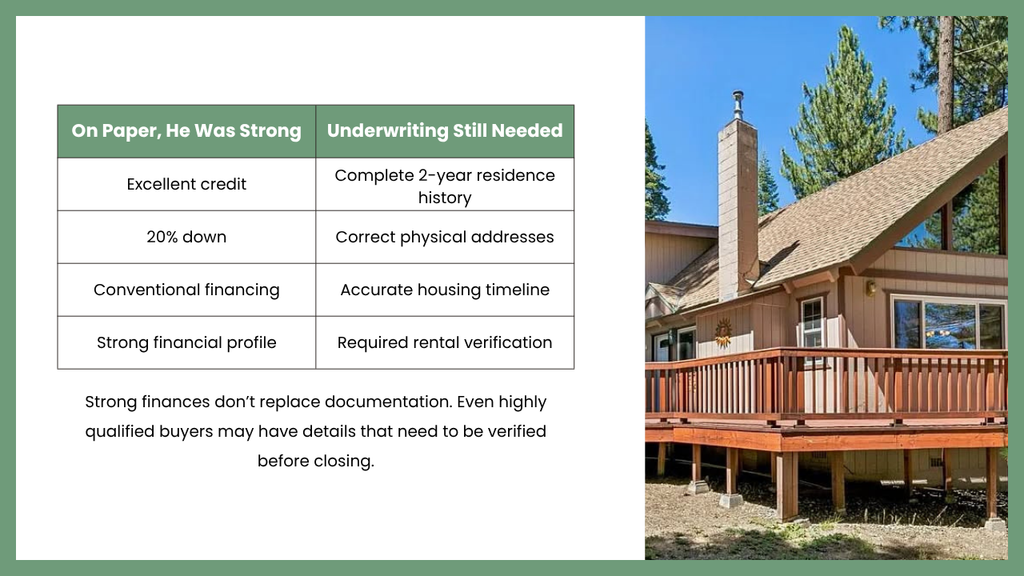
Remember those five years of living without really having a place he considered home?
They mattered to underwriting.
Mortgage applicants are asked to provide a complete two-year residence history, including the physical addresses where they actually resided.
Our buyer’s initial application didn’t completely reflect everywhere he had physically lived during that period.
Once we uncovered the complete history, we had additional documentation to complete.
And here’s what makes this particularly educational.
This buyer had excellent credit.
He was putting 20% down.
He was obtaining conventional financing.
He was a strong borrower.
But a strong financial profile doesn’t automatically eliminate every underwriting requirement.
Based on the Desktop Underwriter findings for this particular loan, we also needed additional verification of his rental and housing history.
Now we had some detective work to do.
We needed to establish the correct physical addresses.
Document the timeline.
Obtain the required verifications of rent.
And do it without losing the short closing timeline.
An Important Lesson for Every Homebuyer
When your mortgage professional asks where you’ve lived during the previous two years, give us everywhere you actually physically resided.
Even if you stayed with friends.
Even if you lived with family.
Even if you rented a room.
Even if you didn’t have a formal lease.
Even if your mailing address was somewhere else.
And even if you don’t consider somewhere you stayed to have been your “home.”
Tell us.
Something that seems insignificant when you’re filling out a mortgage application may become important when the loan goes through underwriting.
Our job isn’t to judge your story.
Our job is to understand it, determine what documentation is required and help you navigate it.
Your financial life doesn’t have to be perfect. It does need to be transparent.
That philosophy is at the heart of my First-Time Home Buyer Resource Center, where buyers can learn about financing, down payments and the homebuying process before they’re ever under the pressure of a purchase contract.
And in this transaction, the irony wasn’t lost on me.
The lifestyle that created extra documentation during the mortgage process was the exact reason buying this home meant so much to him.
He was done being nomadic.
He wanted roots.
Buying Together When Only One Person Will Occupy the Home
There was one more interesting piece to this transaction that created an important planning conversation.
My client was buying the Lake Tahoe home with his partner. His partner already owned and lived in a home in Nevada, so we needed to accurately reflect that the Lake Tahoe property would not be that partner’s principal residence.
The solution for this conventional loan was to include the partner as a non-occupant co-borrower.
That may sound technical, but the concept is actually pretty simple. A non-occupant co-borrower is someone who is a borrower on the mortgage but will not live in the new property as their principal residence. Conventional loan guidelines can permit this structure when the transaction meets the applicable requirements.
Interestingly, my Lake Tahoe buyer could have qualified for the mortgage on his own. His partner wasn’t being added because we needed additional income to make the loan work.
They wanted to buy the home together.
That distinction mattered to them.
When two people are purchasing a home together, it’s important to understand that being on title and being responsible for the mortgage are two different things.
Title determines ownership rights in the property. The mortgage note determines who is legally responsible for repaying the loan. Depending on how a transaction is structured, a person can potentially have an ownership interest without being personally obligated on the mortgage note.
That can create a situation buyers should understand clearly before closing. For example, if one person alone signs the mortgage note while both people take title, the borrower may be solely responsible for repaying the mortgage even though both people have ownership rights in the home.
That doesn’t automatically make the arrangement wrong. There are many legitimate reasons people structure ownership and financing differently. But it does mean the buyers should understand exactly what they’re agreeing to and, when appropriate, discuss title and ownership questions with their title professional or an attorney.
For these buyers, adding the partner as a non-occupant co-borrower allowed the financing to accurately reflect the reality of their situation: they were buying the Lake Tahoe home together, but only one of them would occupy it as a principal residence.
It’s another example of why mortgage planning is about much more than asking, “Can I qualify?”
Sometimes the better question is:
“How should we structure this loan so it accurately reflects how we’re actually buying and using the home?”
First-Time Buyer Doesn’t Mean 20% Down
There’s another homebuying myth this transaction gives me the opportunity to clear up.
Our buyer chose to put 20% down.
But that doesn’t mean every first-time buyer using conventional financing needs 20%.
Qualified buyers may have conventional financing options available with as little as 3% down, depending on the specific program, borrower eligibility and underwriting requirements. My First-Time Home Buyer Resource Center walks buyers through conventional, FHA and other first-time buyer options in plain English.
Buyers who are deciding between loan programs can explore my detailed comparison of FHA versus conventional financing, including how credit, mortgage insurance, property condition and down payment can affect the decision.
For buyers whose biggest obstacle is accumulating the money needed upfront, there may also be California down payment assistance programs worth exploring, along with additional down payment assistance education on my main website.
Twenty percent was simply the strategy this buyer chose based on his financial circumstances and goals.
Another buyer may make a completely different decision.
That’s why good mortgage planning isn’t simply about asking:
“What’s the most you can put down?”
It’s about determining which financing structure makes sense for your goals, available assets and overall financial picture.
And conventional isn’t the only low-down-payment option. The U.S. Department of Housing and Urban Development explains that FHA-insured mortgages may offer down payments as low as 3.5% for eligible borrowers.
Then We Were Racing the Clock
At this point, there were a lot of moving pieces.
Michelle was finalizing negotiations for the $9,000 seller credit and repairs.
Our lending team was working through the residence history and required rental verifications.
The buyers were providing documentation.
Underwriting was clearing conditions.
Title was preparing for closing.
And some of this was happening during the last few days of a very short contract.
Nobody had the luxury of losing several days.
This is where Realtor and lender teamwork matters.
Michelle handled the real estate negotiations.
Our team handled the financing and underwriting.
We communicated.
We solved problems.
And we kept moving.
For first-time buyers wondering what the entire journey looks like beyond this one transaction, I’ve built a complete library of first-time homebuyer loan guides and educational articles covering the decisions buyers encounter along the way.
Funded in 19 Days
Despite the additional address documentation and rental verifications…
Despite the seller-credit negotiations…
Despite repairs being negotiated during escrow…
Despite the short timeline…
We funded the loan in 19 days.
And because the contractual close of escrow was Monday, our team pre-funded on Saturday so the title company could be positioned for a seamless Monday recording.
Three weeks earlier, this started with a text message on a Sunday afternoon.
Now our first-time buyer was about to own his Lake Tahoe dream home.
And while every transaction is different, I love sharing real stories because sometimes seeing another buyer succeed makes homeownership feel a little more possible. One of my other favorite stories is Rehnaz’s journey from wondering whether homeownership was possible to receiving the keys to her first home.
Michelle Keck Was a Rockstar for These Buyers
I have to brag on Michelle Keck, Realtor in South Lake Tahoe because as the lender I had a front-row seat to how she represented these clients.
Michelle was thinking strategically from the beginning.
She looked beyond the pre-qualification letter her buyer already had and thought about the complete offer.
She wanted financing she felt confident presenting.
She wanted a lender who would personally advocate for her buyer.
She wanted a lending team she trusted to perform on the timeline she was negotiating.
Then she helped secure the property.
And after getting the offer accepted, she kept negotiating.
She secured a $9,000 seller credit.
She negotiated repairs.
She advocated for her buyers throughout the transaction.
And she did it under a tight timeline.
That’s a buyer’s agent.
If you’re looking to purchase a home in South Lake Tahoe and want an agent who will strategize, negotiate and advocate for you throughout the transaction, Michelle Keck is an amazing Realtor to have in your corner.
I loved working alongside her on this one.
And Finally, He Gets to Come Home

There are a lot of things I’m proud of about this transaction.
A Sunday pre-approval.
An accepted offer Monday.
A Realtor who negotiated an incredible outcome.
An underwriting hurdle solved.
A 19-day funding.
A Saturday pre-funding to prepare for Monday recording.
But those aren’t the things I’ll remember most.
I’ll remember the conversation with my client when he told me he had essentially been living nomadically for five years.
Because suddenly I understood what we were really working toward.
Not a $750,000 transaction.
Not a conventional mortgage.
Not a 19-day closing.
Home.
For five years, he hadn’t really had one.
Now he does.
His first home.
His Lake Tahoe dream home.
His place to finally put down roots.
Homeownership can represent stability, belonging and the beginning of an entirely new chapter. That’s also why I spend so much time helping buyers work through the mindset that can make homeownership feel possible, especially when the road to getting there hasn’t been conventional.
And after years of moving from place to place, he gets to open his own front door and know:
“I’m home.”
That’s why I still love what I do.
Your Homeownership Story Can Start With a Conversation
You don’t have to have everything figured out before talking with a mortgage professional.
Whether you’re buying your first home, have an unconventional housing history or simply aren’t sure what your financing options look like, start by learning what’s possible.
If you’re still figuring out what kind of property fits your goals, you can also explore the different types of homes first-time buyers can purchase and begin building your own vision of home.
And if putting down roots means making a bigger move or starting a new chapter somewhere new, our Move-Up Buyer and Relocation Resource Center has additional planning and financing resources.
Sometimes understanding what’s possible is the first step toward putting down roots of your own.
❓Frequently Asked Questions
You may need much less than 20% down. Some conventional loan programs allow qualified first-time homebuyers to purchase a one-unit primary residence with as little as 3% down, subject to eligibility and underwriting requirements. Fannie Mae
The buyer in this story chose to put 20% down because that strategy made sense for his financial situation. The right down payment is not necessarily the largest down payment you can make. It is the one that best supports your overall financial goals.
Your residence and housing information helps the lender accurately document your loan application and evaluate your overall housing history. Depending on the loan and underwriting findings, additional documentation of rent or housing payments may also be required.
This is why it’s important to tell your lender everywhere you have actually lived, even if you stayed with family or friends, rented a room, moved frequently, or used a different mailing address.
Yes. Excellent credit and a large down payment do not necessarily eliminate other underwriting or documentation requirements.
Desktop Underwriter evaluates the complete loan file, and rent information can be part of that assessment. Fannie Mae specifically instructs lenders to accurately enter rent information, including former-address rent when a borrower has moved or their rent has changed. Fannie Mae
A non-occupant co-borrower is someone who is a borrower on the mortgage but will not occupy the new property as their principal residence. Under applicable conventional guidelines, non-occupant borrowers may be permitted on certain principal-residence transactions. Fannie Mae Selling Guide
That’s how we structured this transaction for the buyer’s partner, who already had a principal residence in Nevada but wanted to purchase the Lake Tahoe home together with our client.
Potentially, but ownership and mortgage responsibility are two different things, and the exact options depend on the transaction and applicable requirements.
Being on title can provide an ownership interest in the property, while signing the mortgage note creates responsibility for repaying the loan. Before deciding how to hold title with another person, understand both the financing and legal implications and consult the appropriate title or legal professional when needed.
Yes, seller credits may be permitted within applicable loan-program limits and can help pay certain allowable closing costs.
In this transaction, Michelle Keck continued negotiating after the offer had already been accepted and secured a $9,000 seller credit, in addition to negotiating repairs for her buyers.
The amount and permitted use of any seller credit depend on the loan program and individual transaction.
A pre-approval isn’t just about knowing approximately how much you can afford.
When an offer is submitted, the listing side may have questions about financing, documentation and the proposed closing timeline. Having an accessible lending team that can communicate with the listing agent and confidently discuss the buyer’s financing can be valuable.
That’s why Michelle wanted a lender she trusted to be hands-on with this buyer. Once the offer was submitted, I could personally communicate with the listing agent and advocate for our buyer from the financing side.
There is no universal closing time because every borrower, property and transaction is different.
This particular conventional loan funded in 19 days, even though we had additional residence-history documentation, rent verifications, a non-occupant co-borrower structure, seller-credit negotiations and repairs being handled during escrow.
We also pre-funded on Saturday so title could be positioned for the scheduled Monday recording.
The lesson isn’t that every mortgage can or will close in 19 days. It’s that preparation, communication and having an experienced Realtor and lending team working together can make a meaningful difference when time matters.
All loans subject to approval. Equal Housing Lender.
Individual transaction results vary. Seller credits, financing terms, down payment requirements, repairs, closing timelines and underwriting requirements are subject to applicable program guidelines, borrower qualification, property eligibility and individual transaction circumstances. Low-down-payment conventional financing is subject to eligibility requirements, and mortgage insurance may apply.